

Mala Beads — Tools for Meditation
Mala beads are a simple yet powerful string of prayer beads that Buddhists and Yogis have used for hundreds of years to count mantras and prayers with. Japa is the meditation technique used with malas to calm the mind and summon your soul. Worn as a bracelet or necklace, prayer beads also serve as a powerful reminder to be in the present moment and embody peace, love and compassion.
Mala Experts Since 2004
We have been handcrafting our mala prayer beads with semi-precious gemstones, hand-carved bone, rudrakshas, sacred woods and hemp tassels since founding our company in 2004. Our unique gemstone yoga jewelry is “designed by an artist and strung by a yogi.” We offer both 27-bead mala bracelets and full 108-bead mala necklaces for sale. We also import inexpensive Buddhist malas and Hindu prayer beads from India and Nepal. All of our beads are purified and blessed before we send them off to you!
Shop for Mala Beads:
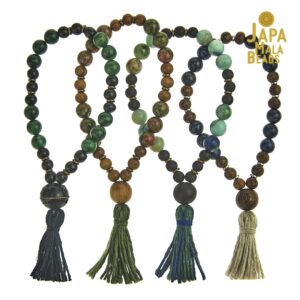
Bracelet Mala Beads
Our Bracelet Malas are made with 27 counting beads and are designed to be worn comfortably around your wrist.
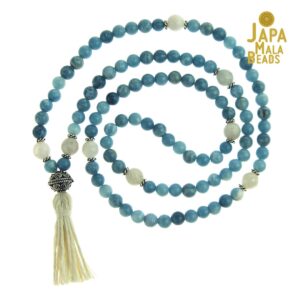
108 Bead Malas
Our full mala beads are made with 108 mantra meditation beads and work best worn as a necklace.

Gemstone Mala Beads
Our healing gemstone malas are handmade in the USA with beautiful and potent semi-precious gemstones.
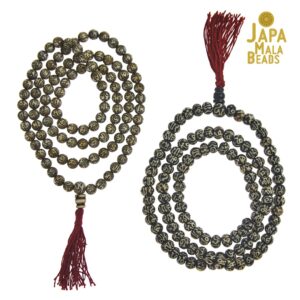
Buddhist Mala Beads
We sell a selection of high-quality Hindu, Tibetan and Buddhist prayer beads imported from India and Nepal.
Malas for Mind-Body Healing
 Our meditation malas have been crafted to be highly potent for spiritual work as well as mind-body healing. The conscious combination of high-grade gemstones with suggested mantras create a powerful synergetic force for healing, meditation, inner peace and well-being. We list the physical and energetic properties of the gemstones as well as suggested mantras for each of our malas. Check out our gemstone healing properties page to learn more about the power of these beautiful beads.
Mala Beads: Our Latest Designs
We are always seeking out new gemstones and creating new yoga jewelry designs. Below are our nine most recent mala creations! Please check out our entire mala collection or shop by 27 bead bracelet malas, 108 bead necklace malas, inexpensive malas made in India, or our healing gemstone collection.
Blue Fire Agate and Selenite Wrist Mala
Peach Calcite and Carnelian Wrist Mala
Black Agate and Onyx Wrist Mala
Crystal Quartz and Purple Tourmaline Wrist Mala
Blue Jade and Aquamarine Wrist Mala
Maifanite and Smoky Quartz Wrist Mala
Hemimorphite and Crystal Quartz Wrist Mala
Red Lodolite and Garnet Wrist Mala
Green Garnet and Moss Agate Wrist Mala
Ultimate Mala Bead Finder
Check out our ultimate prayer bead finder to filter all of our malas by gemstone, intention, chakra, price, color and style!
Why shop at Japa Mala Beads?
• 100% Genuine Beads
All of our gemstone, wood and seed beads are 100% genuine; we do not use any plastic or glass (or any other type of fake beads) in our malas. Some of our stones are slightly enhanced by the manufacturer (which is typical for the entire gemstone industry) but we only purchase the best quality and most natural stones available. Due to the natural materials used the color and the size of the stones we use may vary.
• Sustainable & Eco-friendly
We do our best to run our little mala company with as little impact on the earth as possible. Our japamala tassels are made from eco-friendly hemp. Our packaging is 100% recyclable. We use natural materials in our mala designs. Our website’s server is 100% renewable energy powered.
• Happy Mala Bead Customers
We love hearing feedback about our mala beads, and it makes us happy that our products are helping people live more joyous, centered and spiritual lives. Read what our customers have to say about our meditation beads. (Hint: they love our high-quality, attention to details, and our fast shipping.)
• Malas Made to Last
We have been making and importing prayer beads since 2004 and we strive to produce the most durable japamalas possible. We use the strongest stringing materials available and inspect our beads prior to stringing. We stand behind our products and have one of the best breakage guarantees in the business–108 days! We also provide a very affordable mala restringing and repair service.
• Authentic mala designs
Our malas are based on traditional yoga, Buddhist, and Tibetian prayer bead designs. All of our malas have tassels, a guru (teacher) or meru (mountain) bead, and 108 (or a division of) counting beads. Our malas have been designed specifically for mantra meditation practice.
• Suggested Mala Mantras & Custom mala designs
All of our bracelet and necklace malas have suggested Sanskrit and Tibetian mantras listed. Using these traditional chants is optional, but further increases the potency of the japa meditation practice. We also offer a custom mala design service where we work with you to create a unique japamala for your specific needs.
• Mala of the Month™
Each month we feature one of our mala bead designs with detailed information on it’s recommended mantra and energetic properties as well as a 20% coupon code. Check out our mala of the month page to see this month’s selected malas.